
Agents
NVIDIA Ising Calibration
NVIDIA Ising Calibration 1 is part of the NVIDIA Ising open model family, the first AI models purpose-built for quantum computing workloads. Conductor Quantum contributed to the model and the accompanying benchmark.
Ising Calibration 1 is a 35B-parameter Mixture-of-Experts vision-language model (MoE VLM) fine-tuned to interpret quantum calibration experiment plots and infer the actions needed to tune a quantum processor. It analyses plot images from characterisation experiments (spectroscopy sweeps, Rabi oscillations, readout diagnostics, and more) and produces structured technical assessments: what the experiment shows, whether it succeeded, what parameters to extract, and what to do next.
The model connects directly to an agent to fully automate QPU calibration loops, replacing hours of manual plot inspection with reliable, scalable AI analysis. It is available through the Control API and open weights are on Hugging Face.
Usage
List available agents
Run Ising Calibration on a plot image
Send a base64-encoded calibration plot image and an optional prompt. The agent returns a structured assessment of the experiment.
Async usage
Request body
The VLM endpoint may experience cold-start latency of several minutes on first invocation. Subsequent requests are typically fast.
QCalEval benchmark
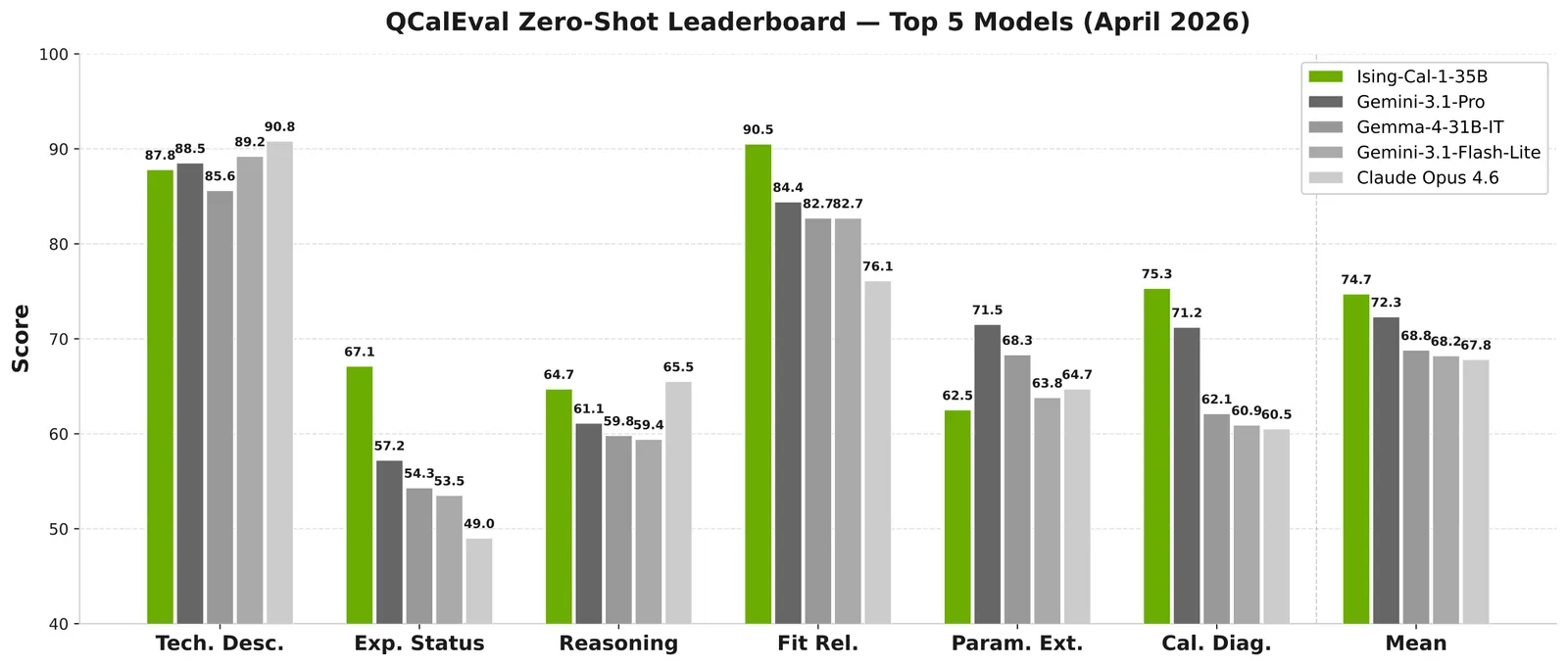
The QCalEval benchmark paper evaluates how well VLMs understand quantum calibration plots. Conductor Quantum contributed alongside NVIDIA and collaborators across national laboratories, universities, and quantum hardware companies. QCalEval is the first comprehensive benchmark for this domain: 243 samples across 87 scenario types from 22 experiment families, spanning superconducting qubits and neutral atoms, evaluated on six question types.
Ising Calibration 1 achieves a 74.7 zero-shot average score on QCalEval, outperforming every general-purpose model tested, including GPT-5.4, Gemini 3.1 Pro, and Claude Opus 4.6. The largest gains come on the tasks that matter most for autonomous calibration: experimental conclusion (+27.2 over base), fit quality assessment (+37.8), and calibration diagnosis (+24.7).